
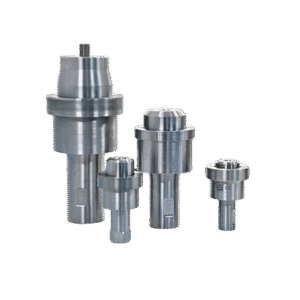
Our ultrasonic boosters (amplitude transformers) convert and amplify mechanical vibrations from 15kHz to 40kHz systems, ensuring optimal energy transfer in plastic welding, metal bonding, and textile sealing applications.
| Frequency Range | 15kHz, 20kHz, 28kHz, 30kHz, 35kHz, 40kHz |
|---|---|
| Amplification Ratio | 1:1.2 to 1:3.5 |
| Materials | Ti-6Al-4V, 4140 Steel, Aluminum 7075 |
| Surface Finish | Ra ≤ 0.8μm (mirror optional) |
Your ultrasonic booster likely overheats due to: frequency mismatch (using the wrong kHz rating), excessive amplitude (beyond its designed ratio), or poor cooling (lack of airflow/water cooling). Other causes include loose mounting (vibration friction), material cracks (fatigue from prolonged use), or contaminated surfaces (dirt/oil disrupting energy transfer).
An ultrasonic booster is a metal component that amplifies or reduces vibration amplitude between the transducer and welding horn. It works by altering the cross-sectional area ratio (e.g., 1:2 ratio doubles the amplitude) at the same frequency (15-40kHz).
Ratio = Output Amplitude ÷ Input Amplitude. Example: 30μm input → 90μm output = 1:3 ratio
Perform:
✅ Visual inspection (cracks/discoloration)
✅ Frequency scan (deviation > ±0.5kHz = faulty)
✅ Amplitude measurement (uneven output = internal fatigue)
Not recommended. Each booster is tuned for specific:
🔧 Amplitude ratio
🔧 Frequency (15/20/30/40kHz)
🔧 Material (titanium for high power, steel for durability)
Booster: Modifies amplitude (mounted between transducer & horn)
Horn (Sonotrode): Directly contacts workpiece for welding