
How to Select 15, 20, 30, 35 or 40 kHz for Ultrasonic Welding
Publish Data:2026.8.16 Author: Hyusonic
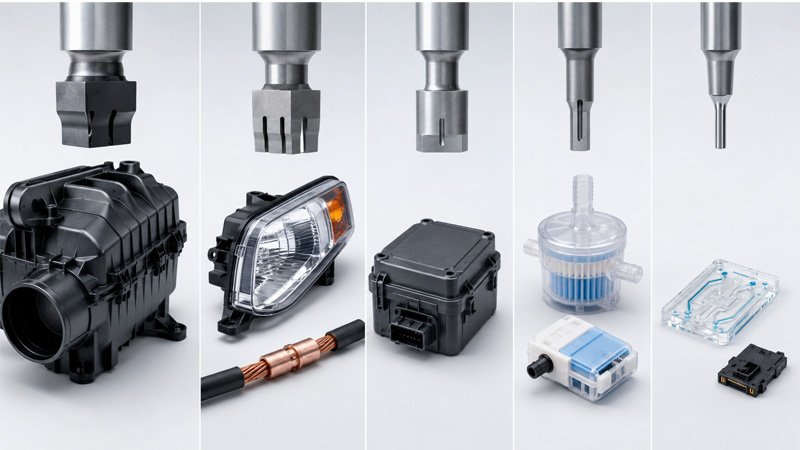
Choosing an ultrasonic welding frequency is not simply a matter of selecting a higher number. Each frequency has a different balance of amplitude, power, tooling size and control.
A 15 kHz system may be suitable for a large plastic housing. A 40 kHz system may be better for a small medical component. For wire harnesses or battery tabs, the answer depends on the metal thickness, weld area and required electrical resistance.
The best frequency is the one that transfers enough energy into the joint without damaging the product.
This guide explains the practical differences between 15, 20, 30, 35 and 40 kHz ultrasonic welding systems.

Quick Ultrasonic Welding Frequency Guide
| Frequency | Typical Strength | Common Applications |
|---|---|---|
| 15 kHz | High amplitude and high energy | Large plastic parts, thick walls, soft plastics |
| 20 kHz | Strong and versatile | General plastic welding, automotive parts, metal welding |
| 30 kHz | Balanced power and precision | Medium-size parts, packaging, electronics |
| 35 kHz | Precise energy control | Medical devices, sensors, small housings |
| 40 kHz | Low amplitude and fine control | Thin walls, delicate parts, films and micro-components |
These ranges are starting points. They are not final specifications. The part must still be tested with the actual resin, joint design and production fixture.
What Does Ultrasonic Welding Frequency Mean?
Frequency is the number of mechanical vibration cycles produced each second.
A 20 kHz ultrasonic welder vibrates 20,000 times per second. A 40 kHz machine vibrates 40,000 times per second.
In a typical system, lower frequencies produce higher mechanical amplitude. They can transfer more energy into large or difficult parts. Higher frequencies use lower amplitude. They offer finer control for small or sensitive parts.
Frequency also affects the size of the acoustic stack. This stack includes the generator, transducer, booster and horn. These components must be designed to operate together at the same frequency.
You cannot convert a 20 kHz machine into a 40 kHz machine by changing a setting on the screen. The complete acoustic system must match the selected frequency. You can learn more about these components on the Hyusonic ultrasonic system page.
When Should You Choose 15 kHz?
A 15 kHz ultrasonic welding machine is often used for large thermoplastic parts.
It provides high amplitude and strong energy transmission. This helps when the weld joint is far from the horn contact area. It can also help with thick walls and softer materials that absorb vibration.
Common applications include:
- Large automotive interior parts
- Appliance housings
- Large filters and containers
- Thick polypropylene components
- Far-field plastic welding
The main limitation is tooling size and noise. A 15 kHz horn is usually larger than a higher-frequency horn. The operating frequency is also closer to the audible range. A suitable sound enclosure may be required.
Choose 15 kHz only when the part needs high energy and the joint geometry supports it.
Why Is 20 kHz the Most Common Choice?
A 20 kHz ultrasonic welder offers a practical balance of power, tooling flexibility and process control.
It is widely used for medium and large thermoplastic parts. It is also common in ultrasonic metal welding.
Typical plastic applications include automotive lamps, dashboards, battery housings, fluid reservoirs and consumer products. Metal applications include copper wire splicing, terminals, busbars and battery tabs.
For many industrial projects, 20 kHz is the first frequency tested because it can handle a broad range of part sizes and materials.
Hyusonic offers ultrasonic plastic welding machines for standard production, precision welding and automated assembly. For copper, aluminum, wire harnesses and battery components, see our ultrasonic metal welding systems.
When Is 30 kHz a Better Choice?
A 30 kHz system sits between the power of 20 kHz and the precision of 35 or 40 kHz.
It is useful when a 20 kHz system is too aggressive, but a 40 kHz system cannot provide enough energy or tooling coverage.
Typical applications include:
- Medium-size plastic housings
- Packaging components
- Electronic enclosures
- Cosmetic parts
- Thin automotive components
- Ultrasonic staking and spot welding
Thirty kilohertz can also be useful when appearance is important. The lower amplitude may help reduce marking, flash and surface damage.
However, the part still needs a well-designed energy director. Frequency cannot correct a weak joint design.
Why Choose 35 kHz Ultrasonic Welding?
Thirty-five kilohertz is widely used for precision plastic assembly.
It works well on small and medium parts that require controlled energy input. Common examples include medical filters, diagnostic components, sensors, connectors and electronic housings.
A 35 kHz machine is often considered when the application requires:
- Low visible marking
- Tight collapse-distance control
- Thin or delicate walls
- Reliable hermetic sealing
- Detailed weld data
- Integration with automated production
Current B2B demand is moving toward servo control, real-time weld curves and process traceability. Modern servo systems can collect weld data at very short intervals and improve process validation. This is especially important in medical, automotive and electronics production. Dukane’s servo welding overview provides one industry example of this direction.
When Should You Use 40 kHz?
A 40 kHz ultrasonic welder is designed for small, delicate and close-tolerance parts.
It normally uses lower amplitude than a 20 kHz system. This allows energy to be applied with more control. The horn is also smaller, which is useful when the weld area is narrow.
Typical applications include:
- Medical disposables
- Microfluidic products
- Small electronic components
- Thin plastic films
- Small sensors
- Precision staking
- Textile and nonwoven spot welding
Forty kilohertz is not automatically more accurate. A poor fixture, unstable pressure or incorrect horn design can still produce an inconsistent weld.
It is also not the best choice for every large part. A small 40 kHz acoustic stack may not deliver enough energy across a wide weld area.
Five Factors That Decide the Right Frequency
Before selecting an ultrasonic welding machine, review these five points.
1. Part Size
Large parts usually need a lower frequency. Small parts often benefit from a higher frequency.
2. Material
Rigid amorphous plastics such as ABS and PC usually transmit ultrasonic energy well. Softer or semi-crystalline materials such as PP and PE may need higher amplitude and a stronger energy director.
3. Distance to the Joint
Near-field welding places the joint close to the horn. Far-field welding sends vibration through more material. Far-field applications often favor lower frequencies.
4. Quality Requirement
A basic assembly may only require time and pressure control. A medical or automotive part may require energy limits, collapse distance, force monitoring and complete weld records.
5. Production Method
A manual workstation has different requirements from an automated line. Check the required PLC connection, communication protocol, recipe storage and defective-part output.
Frequency is only one parameter. Amplitude, pressure, weld time, trigger force and hold time must also be optimized. See our detailed ultrasonic welding parameter guide for the next step.
Do Not Select a Machine from Frequency Alone
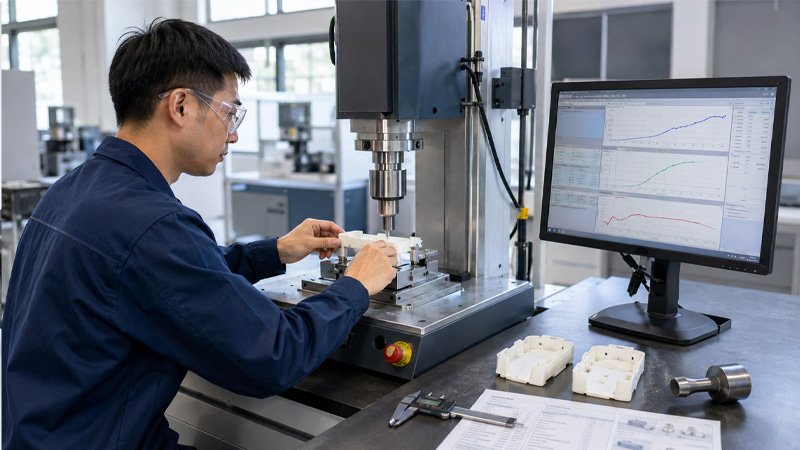
Two parts made from the same plastic may require different equipment. Wall thickness, resin grade, fillers, joint geometry and fixture support can change the result.
That is why a sample welding test is important before a wholesale or production order.
For an accurate evaluation, provide:
- 2D or 3D part drawings
- Plastic or metal grade
- Part dimensions
- Required weld strength
- Airtightness or leak standard
- Expected production volume
- Acceptable appearance
- Automation requirements
Hyusonic can review the application, recommend a starting frequency and test the real parts. The test should confirm weld strength, appearance, cycle time and process stability.
Contact Hyusonic to request a welding test or a custom ultrasonic welding solution.
Final Recommendation
Choose 15 kHz for large parts that need high amplitude. Choose 20 kHz for general industrial welding and many metal applications. Use 30 kHz when you need a balance between energy and precision. Consider 35 kHz for controlled medical, automotive and electronics assembly. Use 40 kHz for small and delicate components.
Treat this as a starting framework, not a fixed rule.
The final choice should come from part drawings, material data, joint design and real welding trials. A properly matched ultrasonic system will give you better weld strength, lower reject rates and a more stable production process.