
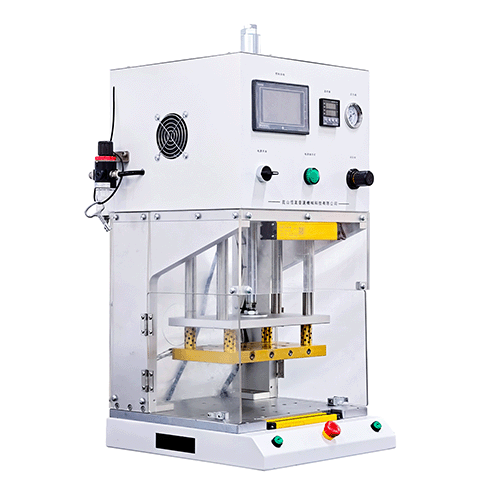
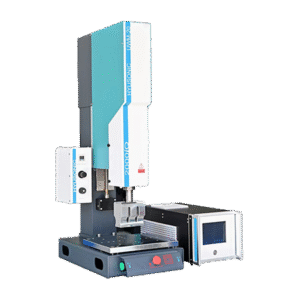
Desktop Heat Staking Machine
-
Precision Temperature Control
Programmable heating zones for accurate staking -
Compact Desktop Design
Space-saving structure ideal for workbenches and labs -
CE & ISO 9001 Certified
Compliant with EU safety standards and international quality management. -
User-Friendly Interface
Intuitive touchscreen or button operation -
Multi-Material Compatibility
Works with ABS, PP, PC, glass-filled plastics, etc.
description
The Desktop Heat Staking Machine is a compact yet powerful solution for precision thermal staking of thermoplastic components. Designed for engineering labs, small-scale production, and high-mix environments, this benchtop system combines high temperature accuracy with modular flexibility. It uses a heated metal probe to soften and deform plastic bosses, rivets, or studs, permanently locking them to mating components without screws or adhesives.
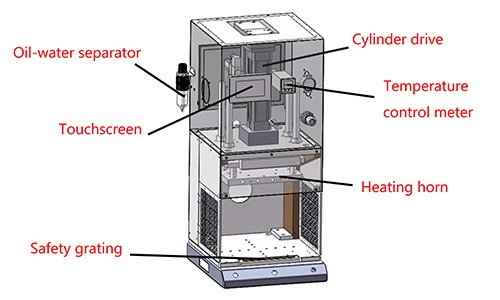
With a customizable staking horn, programmable temperature, and dwell time, as well as optional digital displays, operators can easily adapt to a wide variety of plastic types, including ABS, PP, PC, PA, and glass-fiber-reinforced materials. The machine supports multi-point staking, height-adjustable fixtures, and consistent repeatability for reliable performance across batches. Its clean, semi-automated operation makes it ideal for applications in automotive electronics, medical devices, and consumer product assemblies.
Whether you’re developing prototypes or refining assembly processes, the Desktop Heat Staking Machine delivers industrial-grade results in a space-efficient, operator-friendly format.
Why Desktop Heat Staking Machine Stand Out
Precision Thermal Control
The machine offers highly accurate temperature regulation and programmable dwell time, ensuring consistent results across different plastic types, including glass-fiber-reinforced materials.
Compact & Modular Design
With a small footprint and modular head system, it’s perfect for benchtop environments and adaptable to both single-point and multi-point staking operations.
Tool-Free Setup & Repeatability
Quick-change fixtures and intuitive controls allow fast setup and repeatable performance—ideal for prototyping, low-volume production, and high-mix assembly lines.
Advantages
Beyond core features, this desktop heat staking machine stands out for its low maintenance needs, energy efficiency, and compatibility with automation-ready systems. Its quiet operation and ergonomic layout also improve operator comfort, making it ideal for extended use in precision-driven environments like medical, automotive, and electronics assembly.
Heat Staking VS Ultrasonic Welding
The working principle of ultrasonic plastic welding relies on high-frequency vibrations—transmitted as acoustic and standing waves—to generate intermolecular friction, causing polymer chains to heat and reorganize. However, if the equipment lacks stability, the intense mechanical stress generated can easily fracture delicate internal wire bonds or dislodge solder pads. Conversely, a heat staker utilizes a pure static thermal conduction mechanism. It precisely elevates the temperature past the glass transition temperature ($T_g$), pushing the polymer into a viscous flow state. The equipment then applies minimal vertical pressure to induce plastic deformation, cooling into a permanent mechanical lock.
The Core Advantages:
Zero-Destructive “Static” Forming: Completely devoid of high-frequency mechanical waves, making a heat staking machine the perfect process for encapsulating stress-sensitive components like medical-grade electronics and smart automotive dashboards.
Mastering Advanced Modified Materials: For glass-fiber-reinforced plastics (GFRP), ultrasonic plastic welding often causes uneven energy distribution or broken fibers due to the massive acoustic impedance mismatch between the resin and glass fibers. Instead, the uniform thermal conduction of heat staking equipment melts the matrix resin evenly to encapsulate mating parts, ensuring superior structural integrity.
Divergent Structural Goals Between Ultrasonic Welding and Heating Staking
The true precision of an ultrasonic plastic welder lies in its microscopic fusion and hermetic sealing capabilities. In the medical industry, an ultrasonic plastic welding machine is predominantly used to join two halves of plastic enclosures (e.g., IV filters, hemodialysis tube connectors, microfluidic chips). Its precision is demonstrated by creating highly uniform, pressure-resistant, and watertight seams within milliseconds, without chemical adhesives. For edge-to-edge melting of pure plastics, ultrasonic plastic welding is the absolute industry standard—provided there are no ultra-fragile, exposed floating components inside the housing.
In contrast, the perfection of a desktop heat staking machine lies in the mechanical fastening of dissimilar materials. When you need to secure a densely populated PCB onto a plastic chassis, hermetic sealing is irrelevant; robust fixation is the goal. A heat staking machine achieves this by passing pre-molded plastic studs through the PCB holes. A heated thermal probe then melts these studs into solid “mushroom heads,” clamping the board firmly in place. It is the ultimate solution for joining plastics to non-plastics, such as metal brackets or PCBs.
What Our Clients Say
Customer FAQs
What is a heat staking machine used for?
A heat staking machine is used to permanently join thermoplastic components by melting and reforming plastic studs or bosses over another part, creating a strong mechanical bond without adhesives or fasteners.
How does a heat staking machine work?
The machine uses a heated tool (called a stake) to soften a plastic projection, which is then formed into a specific shape to hold parts together. It combines heat, pressure, and dwell time for precise joining.
What materials are compatible with heat staking?
Heat staking works best with thermoplastics such as ABS, PP, PC, PA, and their glass-filled variants. It can also join plastic to non-plastic components like PCBs, metals, or films.
What industries use heat staking machines?
Heat staking is widely used in automotive, consumer electronics, medical devices, appliances, and plastic enclosures that require clean, permanent fastening.
How do I choose the right heat staking machine?
Consider part size, production volume, compatible materials, heating method (thermal, infrared, etc.), and whether desktop or inline automation suits your application best.